
Why Doesn't the Bible Explain the Trinity?
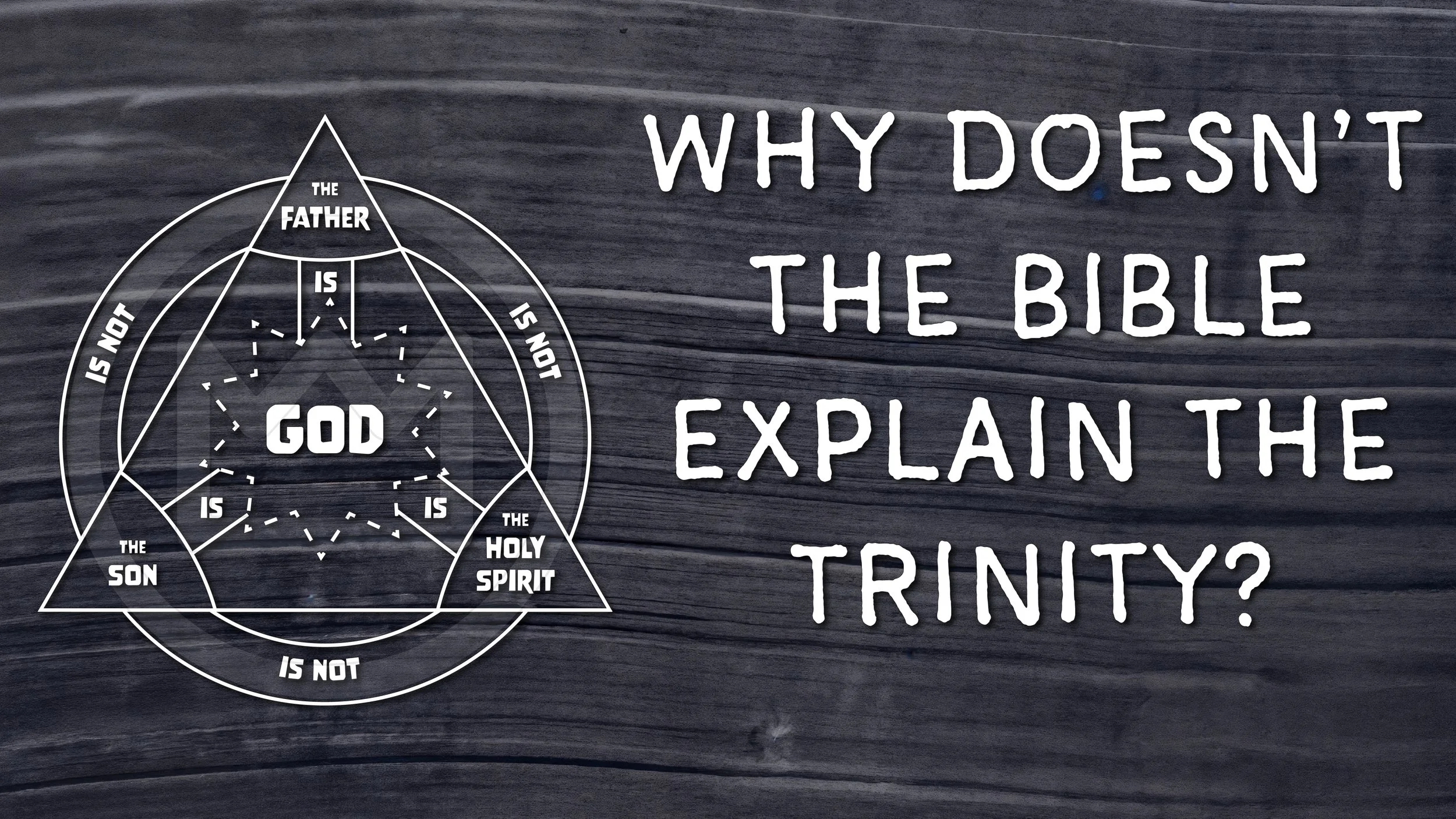
Throughout history, Christians and non-Christians alike have struggled to understand why there is no explicit explanation or teaching in the Bible regarding the doctrine of the Trinity; the idea that the one God exists in three persons: The Father, Son, and Holy Spirit. Misunderstanding surrounding this has even led to the claim that Christians are polytheistic (that we worship more than one God).
So, why doesn't the Bible explain the Trinity? The Bible never gives a formal, systematic explanation of the Trinity. Instead, Scripture reveals it: one God, with the Father, Son, and Holy Spirit each shown to be God, speaking and acting as distinct Persons. Something can be clearly taught without being thoroughly explained or explicitly named.
Because this is such an important and long-standing point of contention, let's dig into it a little deeper. The God of all creation wants to be known; therefore, we must make the effort to know Him.
The Comparison Problem
Let's begin by acknowledging that the claim of one God existing in three Persons is logically impossible for us to wholly explain. The human mind simply cannot fully and accurately describe this divine phenomenon. It violates what we know about nature. In other words, it's super natural.
By using the term “super natural” we mean that it is something above and beyond (more or other) than what we see occurring in nature. There is nothing to which we can compare the trinitarian nature of God. There is no other triune being to which we can draw analogies or likenesses.
We are creatures that rationalize and conceptualize in categories. We know what a chair is because we've experienced other chairs. Therefore, when we come to a new type of a chair, we are instantly able to understand much about it based on our prior experience with other chairs. We do this with everything in creation. As young children, we understand how to function in new spaces and situations because those unfamiliar experiences are understood as our minds draw upon well-understood categories.
But there is nothing and no one like God. He is holy. (What does it mean that God is Holy? See our article God is Holy.)
When we confess that God is holy, we often mean that He is right, or righteous, or good. But, in this case, what we mean is that God is separate, set apart, unlike anything or anyone we've ever encountered. There is no other triune being because God is holy. He can't be fully described or conceptualized by us because we've never experienced any being like Him.
“For this reason You are great, O Lord GOD; for there is none like You, and there is no God besides You, according to all that we have heard with our ears.” (2 Samuel 7:22; bold added)
“'For My thoughts are not your thoughts,
Nor are your ways My ways,' declares the LORD.
'For as the heavens are higher than the earth,
So are My ways higher than your ways
And My thoughts than your thoughts.'” (Isaiah 55:8–9)
So, instead of trying to explain His triune nature in a way that perfectly satisfies us, God has chosen to reveal it to us. No correct explanation will ever be fully satisfying because we have absolutely nothing to compare Him to. It will never be logical because our logical (natural) categories have no space carved out for a super-natural God. The closest we will come this side of heaven is understanding the person and work of Jesus, the Son of God.
Speaking of the Son, Paul writes:
“He is the image of the invisible God, the firstborn of all creation. For by Him all things were created, both in the heavens and on earth, visible and invisible, whether thrones or dominions or rulers or authorities—all things have been created through Him and for Him. He is before all things, and in Him all things hold together.” (Colossians 1:15–17; bold added)
The author of Hebrews speaks of Jesus in this way:
“And He is the radiance of His (the Father's) glory and the exact representation of His nature, and upholds all things by the word of His power.” (Hebrews 1:3; bold added)
When His disciples asked to be shown the Father, Jesus responded:
“Have I been so long with you, and yet you have not come to know Me, Philip? He who has seen Me has seen the Father; how can you say, 'Show us the Father'?” (John 14:9; bold added)
With that said, let's look at how the Bible reveals the triune God — beginning with the truth Scripture never compromises.
One God
Before we look at the three Persons, we must firmly establish what the Scriptures never compromise: there is one God, and only one.
“Hear, O Israel! The LORD is our God, the LORD is one!” (Deuteronomy 6:4; bold added)
“To you it was shown that you might know that the LORD, He is God; there is no other besides Him.” (Deuteronomy 4:35; bold added)
This is where the charge of polytheism falls apart. Those who accuse trinitarians of being polytheists have misunderstood the doctrine. At the heart of trinitarian doctrine is an essential and unwavering commitment to monotheism. The doctrine of the Trinity is not a doctrine of three gods. It is a doctrine of monotheism. The same Scriptures that reveal the Father, Son, and Holy Spirit also declare, without qualification, that there is one God. Israel confessed it every day. Jesus Himself affirmed it as the foremost commandment (Mark 12:29). The apostles never retreated from it (1 Corinthians 8:4).
The question is not whether the Bible teaches one God or three Persons. It teaches both. And it never treats these truths as rivals. God is one. The Father is God. The Son is God. The Spirit is God. Hold these together and you have the Trinity. Not because a council invented it, but because Scripture reveals it.
For more on the oneness of God, see our articles The Unity of God and What Is The Trinity? One God Three Persons.
The Persons of God
With the oneness of God established, let's look at how Scripture reveals each of the three Persons. When disagreements arise over the Trinity, the debate is rarely (if ever) over the person of God the Father. Instead, the dispute is over the second and third persons of the Trinity: The Son and Holy Spirit.
Denial of the godhood of the Son stretches far back into Church history. In A.D. 325, the First Council of Nicaea met to stand against the heretical teaching of Arius of Alexandria (whose teaching became known as Arianism). He explicitly taught that Jesus, rather than being a co-divine, co-eternal member of the Godhead, was a created being.
Arius took statements like the one we saw from Colossians — “He is the image of the invisible God, the firstborn of all creation.” (1:15; bold added) — as teaching Jesus was God's first creation, with all other things then being made through Him.
Instead of the Arian view of this text, the orthodox (correct) view holds that “firstborn” isn't speaking of one who is born first. Rather, firstborn speaks of His preeminence, supremacy, and prominence compared to all else. This text isn't teaching Jesus was created, but that His notability, dominion, and renown exceed all others the way a firstborn son would be viewed as superior to his later-born brothers. Consider that the Bible also says that David was the firstborn (e.g., Psalm 89:20–27) even though we know David was the youngest of his brothers (1 Samuel 16:11–12).
Instead of twisting “firstborn” to mean Jesus was a created being, we should examine verses that do directly speak to Christ's divine nature. We've already seen some. Here are a few more:
“And they all said, 'Are You the Son of God, then?' And He said to them, 'Yes, I am.'” (Luke 22:70)
“In the beginning was the Word, and the Word was with God, and the Word was God. He was in the beginning with God. All things came into being through Him, and apart from Him nothing came into being that has come into being. In Him was life, and the life was the Light of men. The Light shines in the darkness, and the darkness did not comprehend it… And the Word became flesh, and dwelt among us, and we saw His glory, glory as of the only begotten from the Father, full of grace and truth.” (John 1:1–5, 14; bold added)
“And Jesus cried out and said, 'He who believes in Me, does not believe in Me but in Him who sent Me. He who sees Me sees the One who sent Me.'” (John 12:44–45; bold added)
When Jesus proclaimed, “I and the Father are one” (John 10:30), the Jews who heard Him knew exactly what He was asserting: His divinity. Which is why they immediately tried to kill Him (John 10:31).
Similar to Arianism which questioned the divinity of the Son, Macedonianism (otherwise known as Pneumatomachianism) denied the personhood and divinity of the Holy Spirit. This teaching was addressed and formally denied in A.D. 381 at the First Council of Constantinople. Instead of believing that the Spirit is a created, subordinate being (as Macedonianism taught), or that He is an impersonal “force,” let's look at how Jesus speaks of Him.
“I will ask the Father, and He will give you another Helper, that He may be with you forever; that is the Spirit of truth, whom the world cannot receive, because it does not see Him or know Him, but you know Him because He abides with you and will be in you.” (John 14:16–17; bold added)
“I have many more things to say to you, but you cannot bear them now. But when He, the Spirit of truth, comes, He will guide you into all the truth; for He will not speak on His own initiative, but whatever He hears, He will speak; and He will disclose to you what is to come. He will glorify Me, for He will take of Mine and will disclose it to you. All things that the Father has are Mine; therefore I said that He takes of Mine and will disclose it to you.” (John 16:12–15; bold added)
Furthermore, an “impersonal force” can't be blasphemed, resisted, grieved, or quenched (at least not in the way He's spoken of in Scripture).
“Therefore I say to you, any sin and blasphemy shall be forgiven people, but blasphemy against the Spirit shall not be forgiven. Whoever speaks a word against the Son of Man, it shall be forgiven him; but whoever speaks against the Holy Spirit, it shall not be forgiven him, either in this age or in the age to come.” (Matthew 12:31–32; bold added)
“You men who are stiff-necked and uncircumcised in heart and ears are always resisting the Holy Spirit; you are doing just as your fathers did.” (Acts 7:51; bold added)
“Do not grieve the Holy Spirit of God, by whom you were sealed for the day of redemption.” (Ephesians 4:30; bold added)
“Do not quench the Spirit.” (1 Thessalonians 5:19)
Shown, Not Told
It's true, the Lord never inspired any of the human authors of Scripture to describe, define, or fully flesh out the doctrine we call the Trinity. But, as we've seen, the Trinity is there all the same. Our problem isn't that it's not there, it's that we want to be told rather than shown. But, the art of show, don't tell lies at the heart of great storytelling.
The most dramatic and iconic place in Scripture where we are shown and not told is during Jesus' baptism, the very start of His earthly ministry. It's here we see the Son and Spirit and hear the Father:
“After being baptized, Jesus came up immediately from the water; and behold, the heavens were opened, and he (John the Baptist) saw the Spirit of God descending as a dove and lighting on Him, and behold, a voice out of the heavens said, 'This is My beloved Son, in whom I am well-pleased.'” (Matthew 3:16–17)
According to the Apostle John, “No one has ever seen God (the Father) at any time” (John 1:18). But at Jesus' baptism, the Messiah and the Spirit were both seen by man while the voice of the Father could be heard declaring His approval of the Son.
The baptism is not the only place we are shown. When the risen Christ commissioned His disciples, He commanded:
“Go therefore and make disciples of all the nations, baptizing them in the name of the Father and the Son and the Holy Spirit.” (Matthew 28:19; bold added)
Notice: the name (singular) into which disciples are baptized is the name of the Father, Son, and Spirit. One name. Three Persons. Jesus did not say “in the names,” as if speaking of three gods. Nor did He fold the Son and the Spirit into the Father, as if they were mere titles for one Person. In a single breath, the Lord united the three Persons under one divine name.
The Apostle Paul was shown the same reality, and it shaped the way he blessed the churches:
“The grace of the Lord Jesus Christ, and the love of God, and the fellowship of the Holy Spirit, be with you all.” (2 Corinthians 13:14)
Paul closes his letter by invoking all three Persons in one benediction — grace, love, and fellowship flowing from one God. He doesn't stop to explain it. He doesn't need to. He had been shown, and so had his readers.
While many additional examples could be given, consider also how Paul prayed to both God the Father and Jesus our Lord (two Persons), asking that He direct (a singular verb, not plural) Paul's way in 1 Thessalonians 3:11. The plurality of persons and singular verb show Paul's triune understanding in prayer. For those who would argue on grammatical grounds that a plurality of persons with a singular verb merely emphasizes that the first named person (here God the Father) is greater than the second person (in this case, the Son), and that the second person is a mere “tag-along,” consider that Paul does the same thing again in 2 Thessalonians 2:16–17, but reverses the order by naming Jesus before the Father.
Rather than tell us all about the Trinity, God has chosen to show us. Just because “the Trinity” doesn't appear on the pages of Scripture doesn't mean the Trinity doesn't. They are there for all to read. Read and believe.
For more on a Trinitarian model of prayer, see our article Should Christians Pray to the Holy Spirit? A Trinitarian Model of Prayer.
Why Reveal It This Way?
God did not hand us a theology textbook. He revealed Himself in His words, His works, and ultimately in His Son.
“God, after He spoke long ago to the fathers in the prophets in many portions and in many ways, in these last days has spoken to us in His Son, whom He appointed heir of all things, through whom also He made the world.” (Hebrews 1:1–2; bold added)
Revelation unfolded. Israel was given the bedrock first: the LORD is one. Then, in the fullness of time, the Son was sent, and the Word became flesh. Then the risen Christ poured out the promised Holy Spirit at Pentecost. What was revealed “in many portions and in many ways” came into focus as Scripture was written. His self-revelation is distinct and clear enough for all who read the pages of Scripture to see this reality: One God existing in three Persons.
So where did the term “Trinity” come from? From the same place technical terms always come from. Every discipline eventually develops a technical language used as shorthand for what it has observed. The Bible plainly reveals that there is one God. The Bible plainly reveals three divine Persons who are God. As the church discussed what the Bible had shown, it created a term to summarize that understanding. The word “Trinity” (admittedly not found in Scripture) is simply shorthand for what is found in Scripture. On page after page.
Now that we hold the complete Bible, that little word helps Christians quickly confess a beautiful and marvelous revelation of God's character. The term is man's. The truth it summarizes is God's. There is truly no one like Him!
Related Questions
Where did the word “Trinity” come from? The Latin term trinitas (“threeness”) was first applied to God by Tertullian around A.D. 200. The church did not invent a new doctrine; it coined a word to summarize what Scripture had already revealed: one God in three Persons.
Is the Trinity in the Old Testament? The Old Testament stresses that God is one (Deuteronomy 6:4) while containing hints of plurality: “Let Us make man in Our image” (Genesis 1:26) and the Lord sending the Lord and His Spirit (Isaiah 48:16). The full revelation awaited the coming of Christ.
Why do analogies for the Trinity fall short? Every analogy fails because nothing in creation is like God. Water in three states teaches modalism (one God in three modes); an egg teaches partialism (three parts of God). Rather than illustrate the Trinity, such analogies illustrate ancient heresies.
Support our ministry and buy a cool mug:


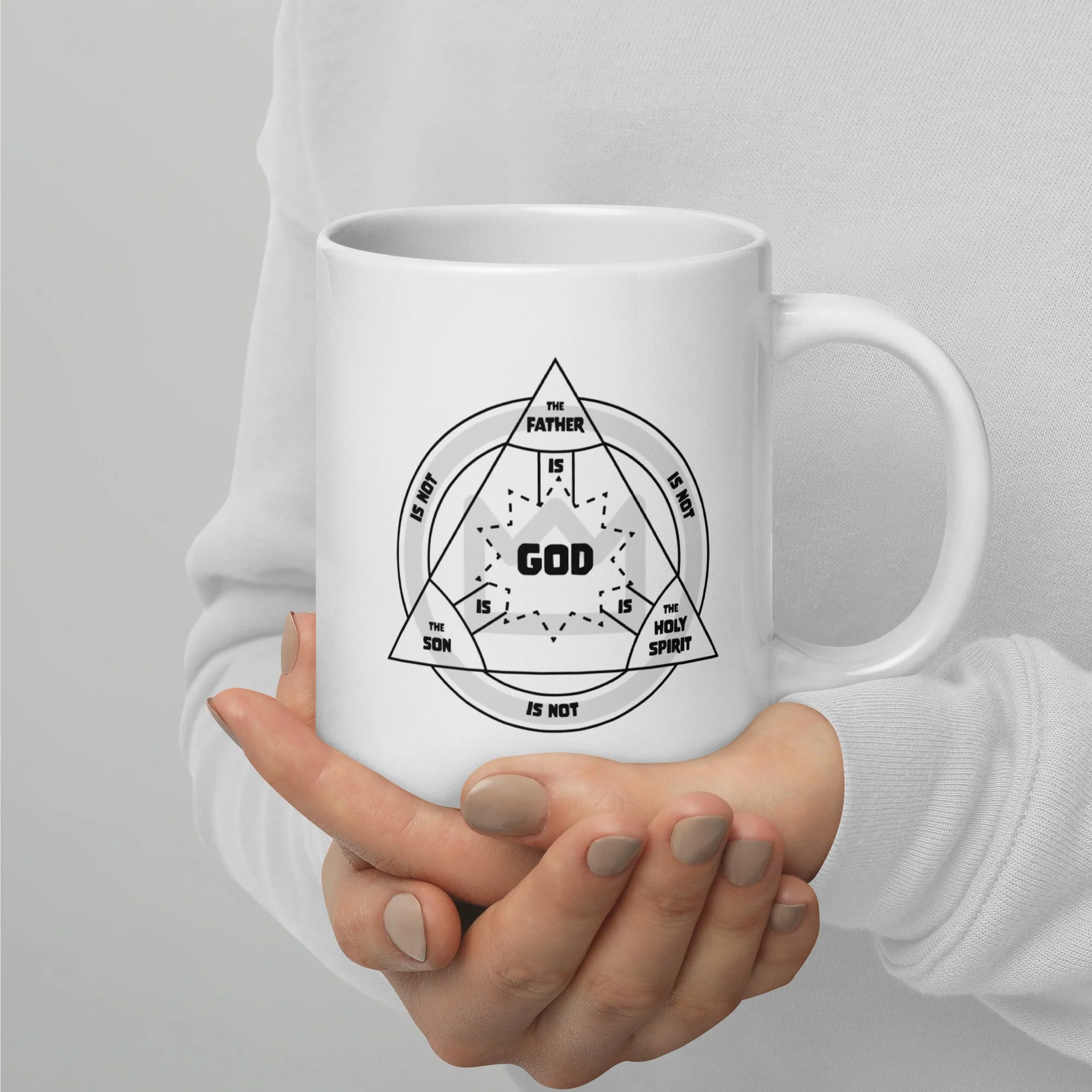
Whether you're drinking your morning coffee, evening tea, or something in between—this mug's for you! It's sturdy and glossy with a vivid print that'll withstand the microwave and dishwasher.
• Ceramic
• 11 oz mug dimensions: 3.8″ (9.6 cm) in height, 3.2″ (8.2 cm) in diameter
• 15 oz mug dimensions: 4.7″ (11.9 cm) in height, 3.3″ (8.5 cm) in diameter
• 20 oz mug dimensions: 4.3″ (10.9 cm) in height, 3.7″ (9.3 cm) in diameter
• Dishwasher and microwave safe
• Blank product sourced from China
This product is made especially for you as soon as you place an order, which is why it takes us a bit longer to deliver it to you. Making products on demand instead of in bulk helps reduce overproduction, so thank you for making thoughtful purchasing decisions!
Age restrictions: For adults
EU Warranty: 2 years
Other compliance information: Meets the lead and cadmium level requirements.
In compliance with the General Product Safety Regulation (GPSR), Oak inc. and SINDEN VENTURES LIMITED ensure that all consumer products offered are safe and meet EU standards. For any product safety related inquiries or concerns, please contact our EU representative at gpsr@sindenventures.com. You can also write to us at 123 Main Street, Anytown, Country or Markou Evgenikou 11, Mesa Geitonia, 4002, Limassol, Cyprus.